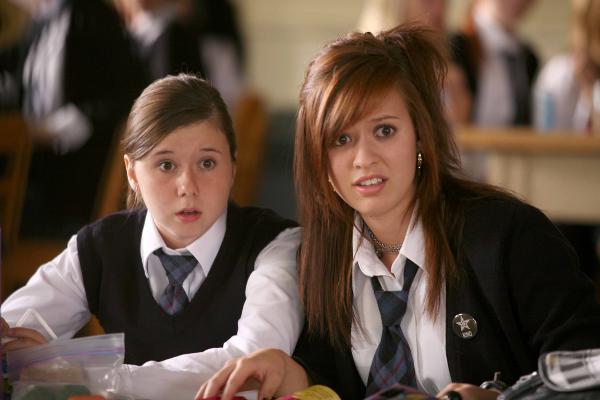
Journal d’Aurélie Laflamme, Le – Film de Christian Laurence

Le Journal d’Aurélie Laflamme est une comédie pour adolescents dont le personnage principal est tiré de la populaire série de livres écrits par l’auteure India Desjardins.

Le journal d’Aurélie Laflamme de Christian Laurence

Le journal d’Aurélie Laflamme de Christian Laurence

Le Journal d’Aurélie Laflamme est une comédie pour adolescents dont le personnage principal est tiré de la populaire série de livres écrits par l’auteure India Desjardins. Ce film est basé sur le premier tome de la série « Aurélie Laflamme, Extraterrestre ou presque ». Le réalisateur Christian Laurence vient du domaine de la télévision et signe ici son premier long-métrage de cinéma.

Comme on pouvait s’en douter d’après les succès obtenus par les livres, Le Journal d’Aurélie Laflamme fut reçu chaleureusement par le jeune public québécois qui en fit l’un des succès au box office de 2010. Au niveau international, le film de Christian Laurence eut droit à quelques sélections dans les festivals francophones, sans toutefois se démarquer outre mesure.

Un second film tiré des aventures d’Aurélie Laflamme a été produit par la suite.

Résumé

Aurélie est une adolescente de 14 ans, un peu perdue et donc en quête de solutions. Entre les habitudes de sa mère sédentaire et les chicanes avec sa meilleure amie, elle rêve à son premier french kiss ! Mais au fond, Aurélie se sent bien seule dans l'’univers, surtout depuis la mort de son père, il ya 5 ans.

Et si son père était simplement un extraterrestre, ayant quitté la Terre pour rejoindre sa planète? Génétique oblige, Aurélie serait elle-même une extraterrestre! Ceci expliquerait bien des choses. Par exemple, pourquoi elle se sent si différente des autres (surtout de sa mère), pourquoi elle n'’est pas capable d’'enligner deux mots sans faire une gaffe, et surtout pourquoi les garçons lui tapent vraiment sur les nerfs.

Synopsis officiel

Distribution

Marianne Verville (Aurélie Laflamme) ; Geneviève Chartrand (Kat) ; Aliocha Schneider (Nicolas) ; Jérémie Essiambre (Truch) ; Edith Cochrane (mère d’Aurélie) ; Pierre Gendron (Denis Beaulieu) ; Valérie Blais (Marie-Claude) ; Sylvie Potvin (Soeur Rose)

Fiche technique

Genre: Comédie dramatique - Origine: Québec, 2009 - Sortie en salles: 23 avril 2010 dans 83 salles au Québec - Durée: 1h48 - Classement: Général - Tournage: septembre-octobre 2009 - Budget approximatif: 4,1 M$

Réalisation : Christian Laurence - Scénario : Christian Laurence et India Desjardins, d'après le roman éponyme d'India Desjardins - Production : Claude Veillet et Lucie Veillet - Société de production : Films Vision 4 - Distribution : TVA Films

Équipe technique - Costumes : Julie-Anne Tremblay - Direction artistique : Marc Ricard - Montage : Hubert Hayaud - Musique : Martin Léon - Photographie : Geneviève Perron

Replace the miscommunication breakup with an external obstacle . Mature couples actually talk. In Bridgerton Season 2, the longing worked because the obstacle was societal (duty to the sister), not a stupid lie. To fix a broken romantic storyline, writers must ask: Would two adults who like each other actually act this way? If the answer is no, rewrite the scene. The Trope to Revive: The Slow Burn Streaming services have killed the slow burn. Because audiences binge, writers feel they need a kiss by Episode 2. Compare Nobody Wants This (Netflix) to Ted Lasso (Apple). The best romantic storyline in recent memory is Roy and Keeley —not because it was fast, but because it was earned over 30 episodes of friendship and growth.

Delay gratification. Bring back the "will they/won't they" that defined Moonlighting and The X-Files . If a couple gets together in the first season, by the third season we will be bored, and the writers will resort to cheating scandals to keep us interested (see: Jane the Virgin ). The Dialogue Fix Stop having characters announce their feelings. "You are the love of my life and I cannot breathe without you" is lazy. The Fix: Use behavioral dialogue . Show love through action. In Past Lives , the leads say very little about love, but you feel the ache of a thousand lifetimes. To fix a romantic storyline, cut 50% of the "I love yous" and replace them with knowing glances, inside jokes, and acts of service. Part 4: The Manifesto – A New Contract for Romance (Real & Reel) If we truly want to fix famous Insta relationships and romantic storylines, we need a cultural reset. We, the audience, are complicit. We demand content 24/7, and we punish celebrities who go private. We binge shows in one night and then complain that the romance felt rushed.

That is the only storyline that deserves a sequel.

Transparency. Instead of gaslighting the audience into believing a contractual obligation is a soulmate connection, publicists should rebrand the "PR relationship" as a "Professional Creative Partnership." Call it what it is. When the audience feels lied to (e.g., the Don't Worry Darling drama), we stop caring. If Harry Styles and Olivia Wilde had just said, "We are having fun on set and seeing where it goes," rather than the glossy magazine covers, the backlash would have been halved. Part 2: Surgical Strikes – Fixing Specific Famous Instagram Disasters Let’s get into the mud. Here are three archetypal "Insta relationship" catastrophes and the surgical fixes they require. Case Study #1: The "Over-Exposed" Couple (The Shawn & Camila Model) The Problem: They sang about loving each other "for life" on a global hit single, posted constant make-out sessions, and moved in together during lockdown. By the time they broke up, the audience was exhausted. The Fix: A Digital Detox Mandate . For a relationship to survive Instagram, it must have a password that the other partner does not know. If Shawn Mendes and Camila Cabello had imposed a "three-post-per-couple-per-month" limit, they would have built anticipation rather than fatigue. They needed to leave the audience wanting more, not begging them to stop. Case Study #2: The "Liking Hate Comments" Debacle (The Khloé Kardashian Model) The Problem: One partner is publicly humiliated (Tristan Thompson/Khloé). Instead of privacy, the pain is monetized via "likes" on shady memes and family reactions on the Hulu show. The Fix: The Neutral Zone . Fixing this means implementing a strict "No Social Media Sub-tweeting" clause. If Khloé had simply stated one time, "I am disappointed, and I am seeking private legal/emotional counsel," and then gone dark , she would have retained her power. Every time you like a post calling your ex a "narcissist," you lose the moral high ground. Silence is the only repair tool here. Case Study #3: The "Soft Launch to Hard Flop" (Timothée Chalamet & Kylie Jenner) The Problem: The ambiguity is infuriating. Is it a PR stunt? Is it real? The lack of clarity creates a vacuum filled by conspiracy theories. The Fix: The Singular Confirmation. One post. One caption. No stories. If Timothée had posted a single black-and-white photo of two hands holding at a random diner, with no hashtags, and then never mentioned it again, the pressure would dissipate. The chaos comes from the breadcrumbing —the constant drip of "maybe they are/maybe they aren't." Pick a lane, or get off the road. Part 3: The Fiction Fix – Repairing Broken Romantic Storylines Instagram isn't the only culprit. Our favorite TV shows and movies have forgotten how to write love. Writers today confuse "drama" with "toxicity," and "subversion" with "depression." The Trope to Kill: The Third Act Breakup Why do two people who have survived a zombie apocalypse, a magical curse, or a corporate takeover suddenly break up because of a misunderstanding ? (Looking at you, The Kissing Booth and literally every rom-com on Netflix).