Related Resources
Take your learning further with these popular English study packs.
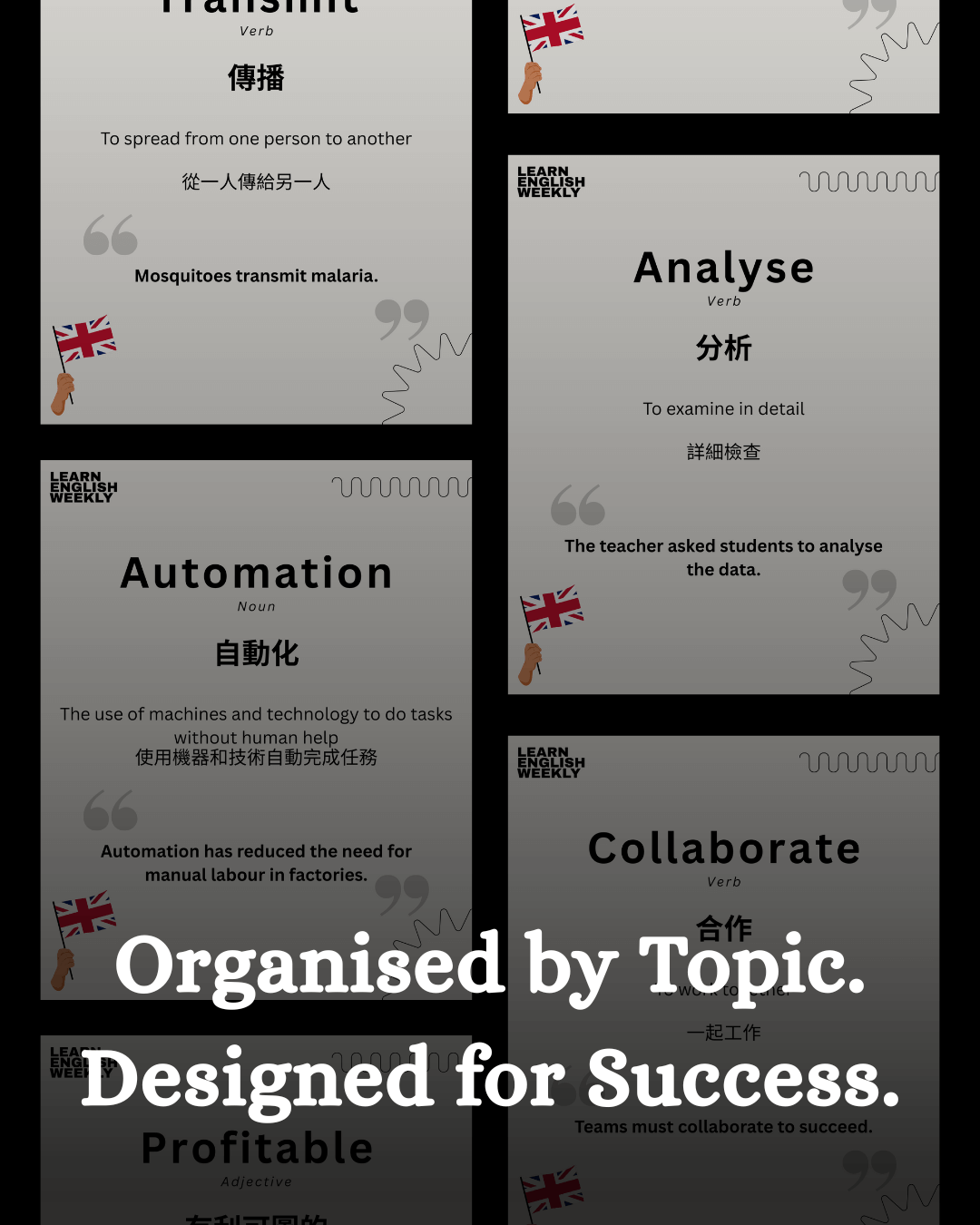
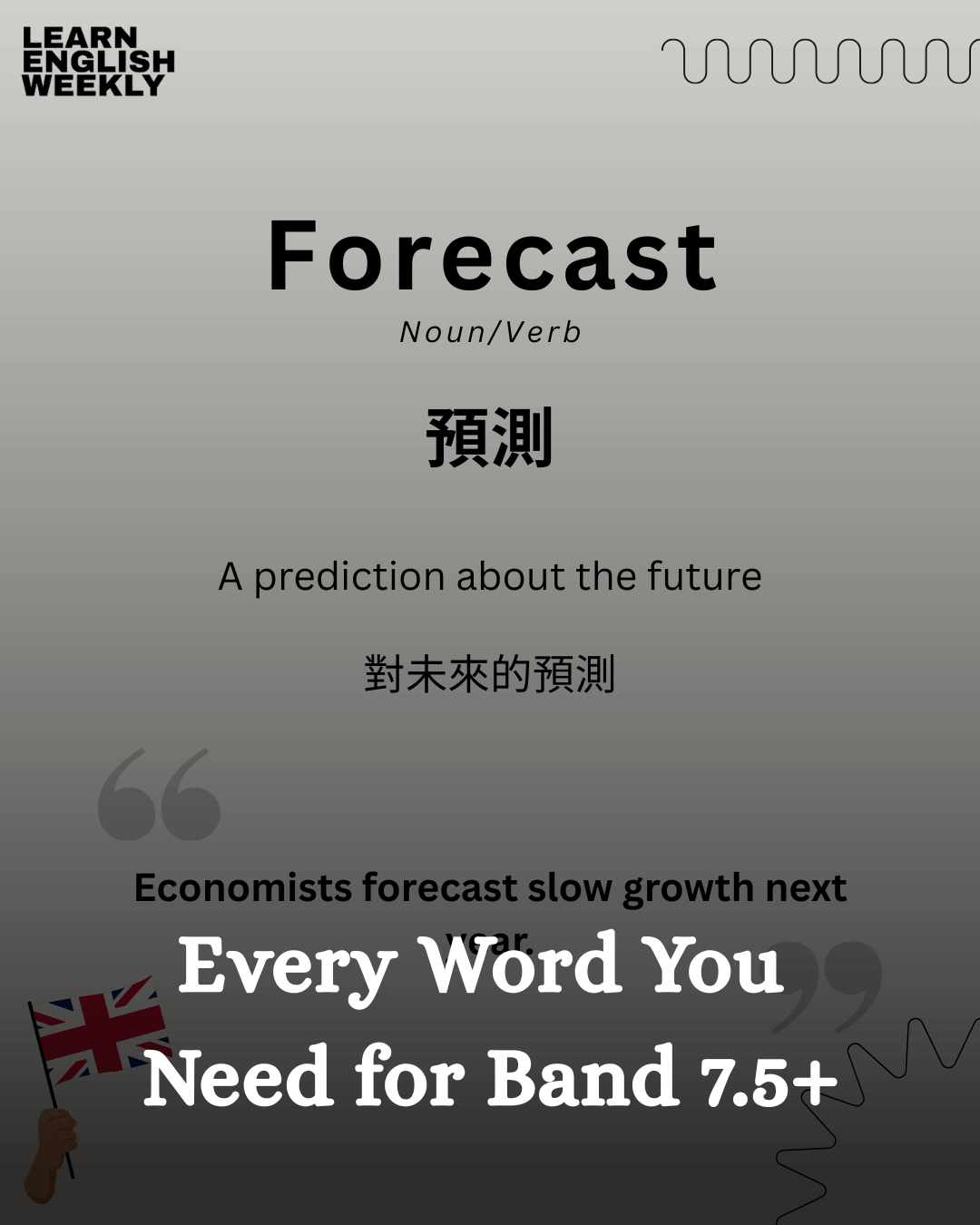
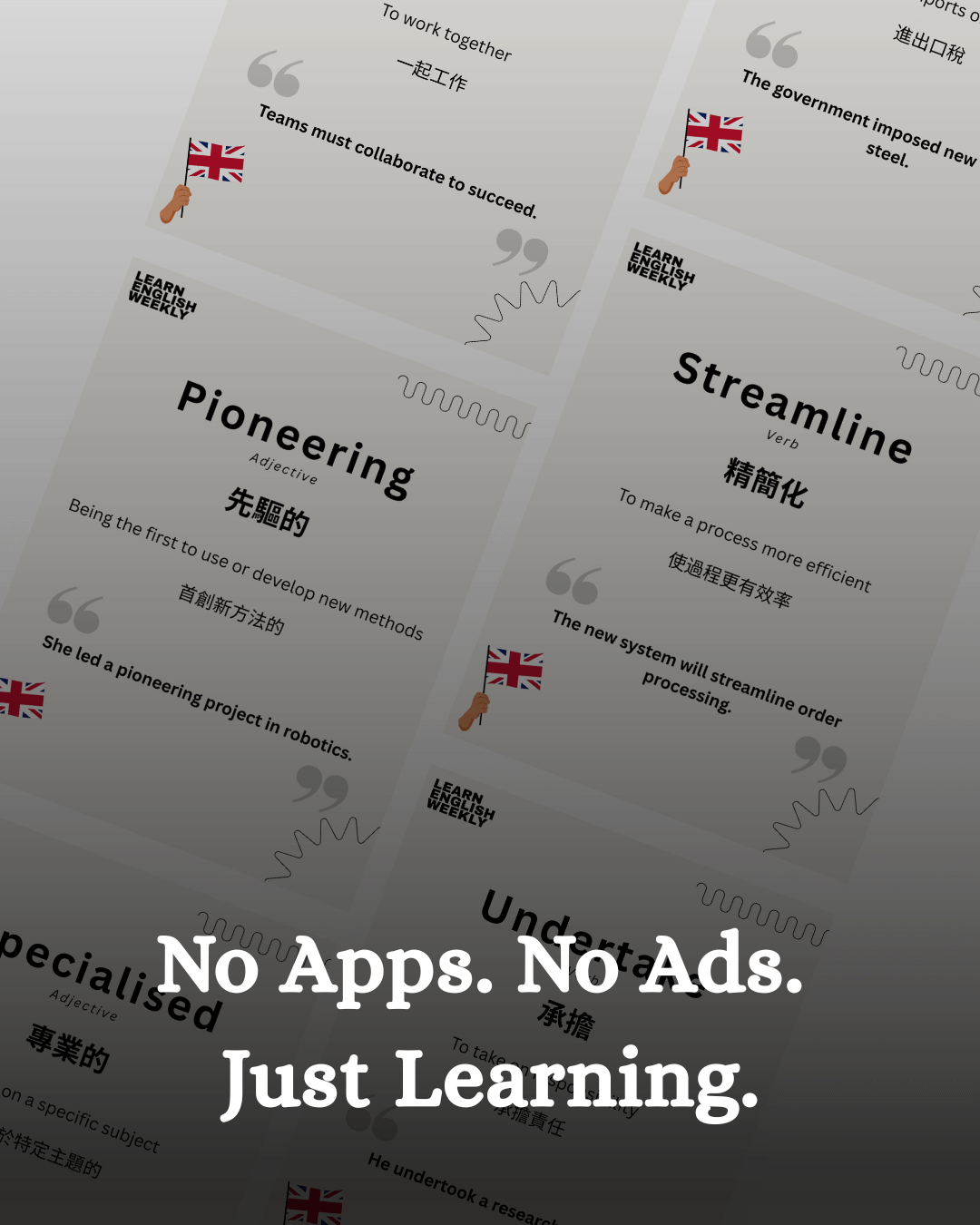
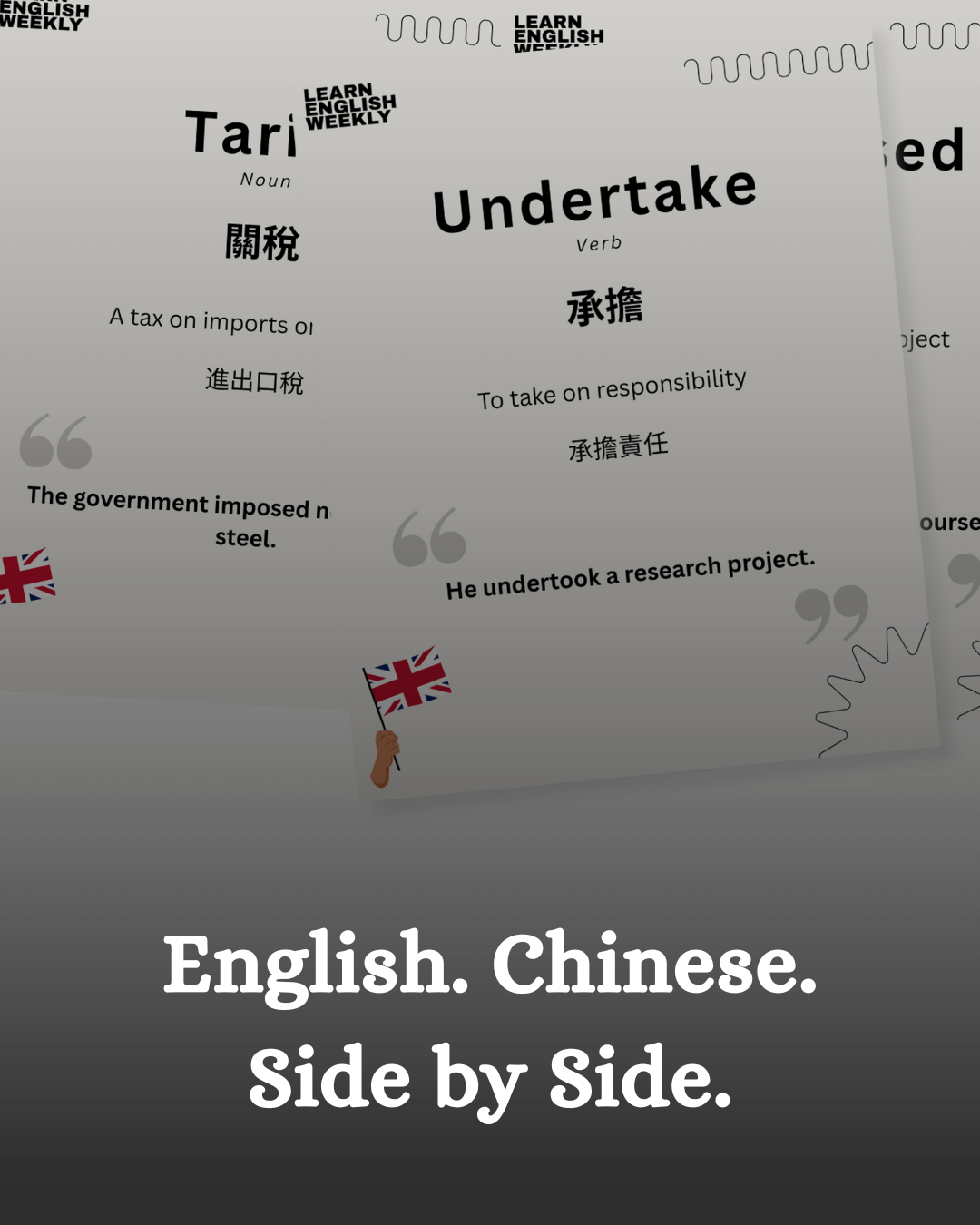
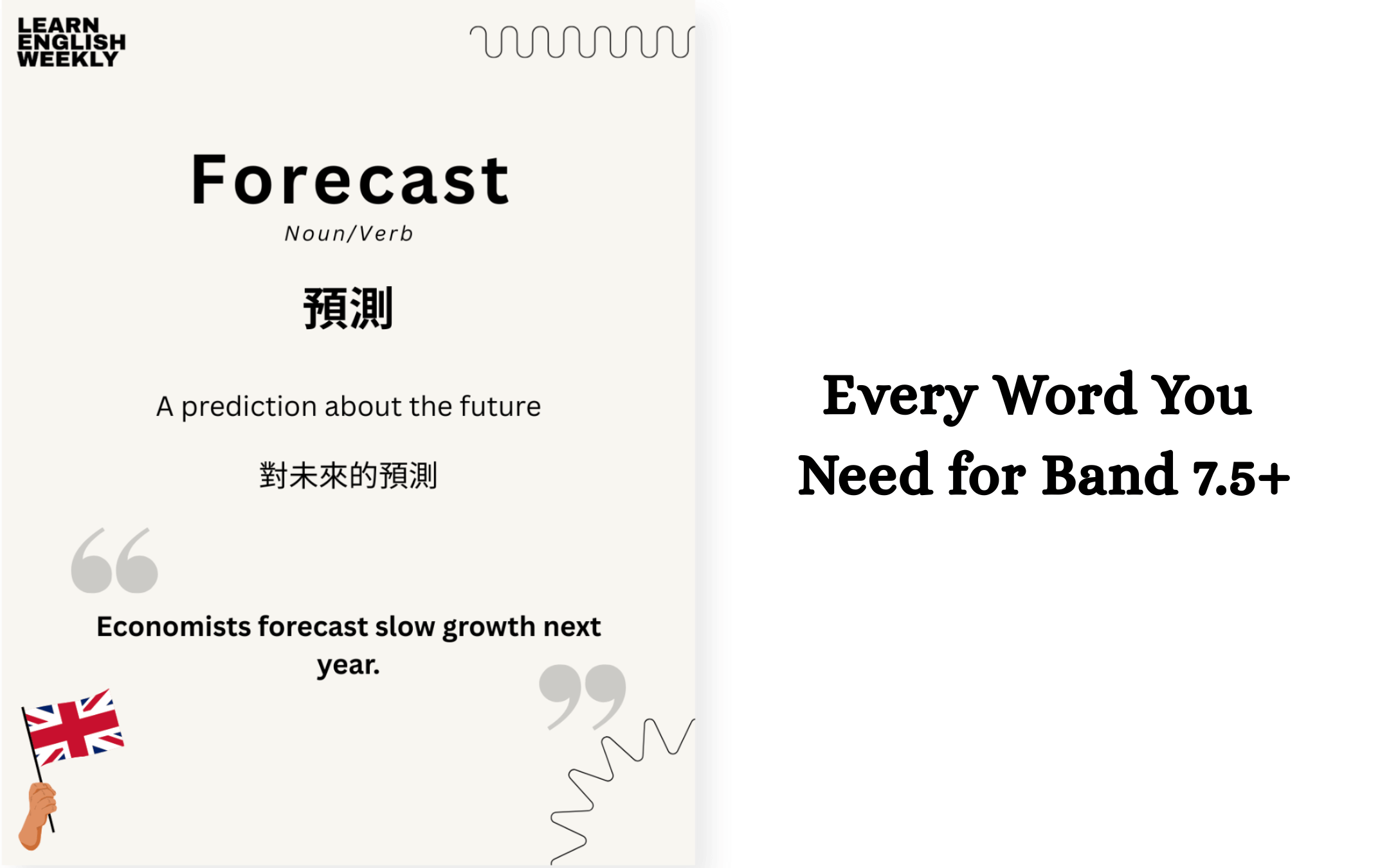
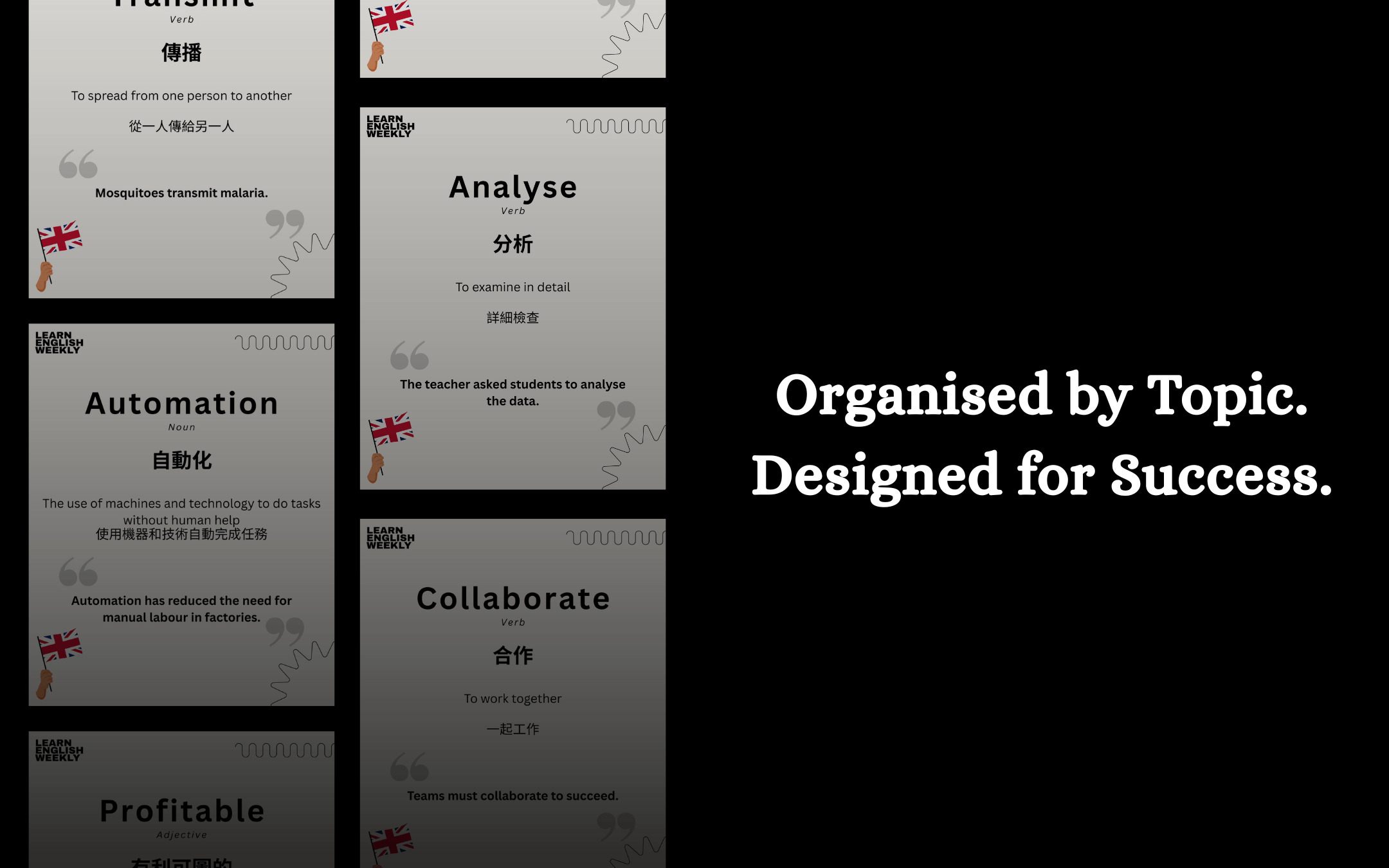
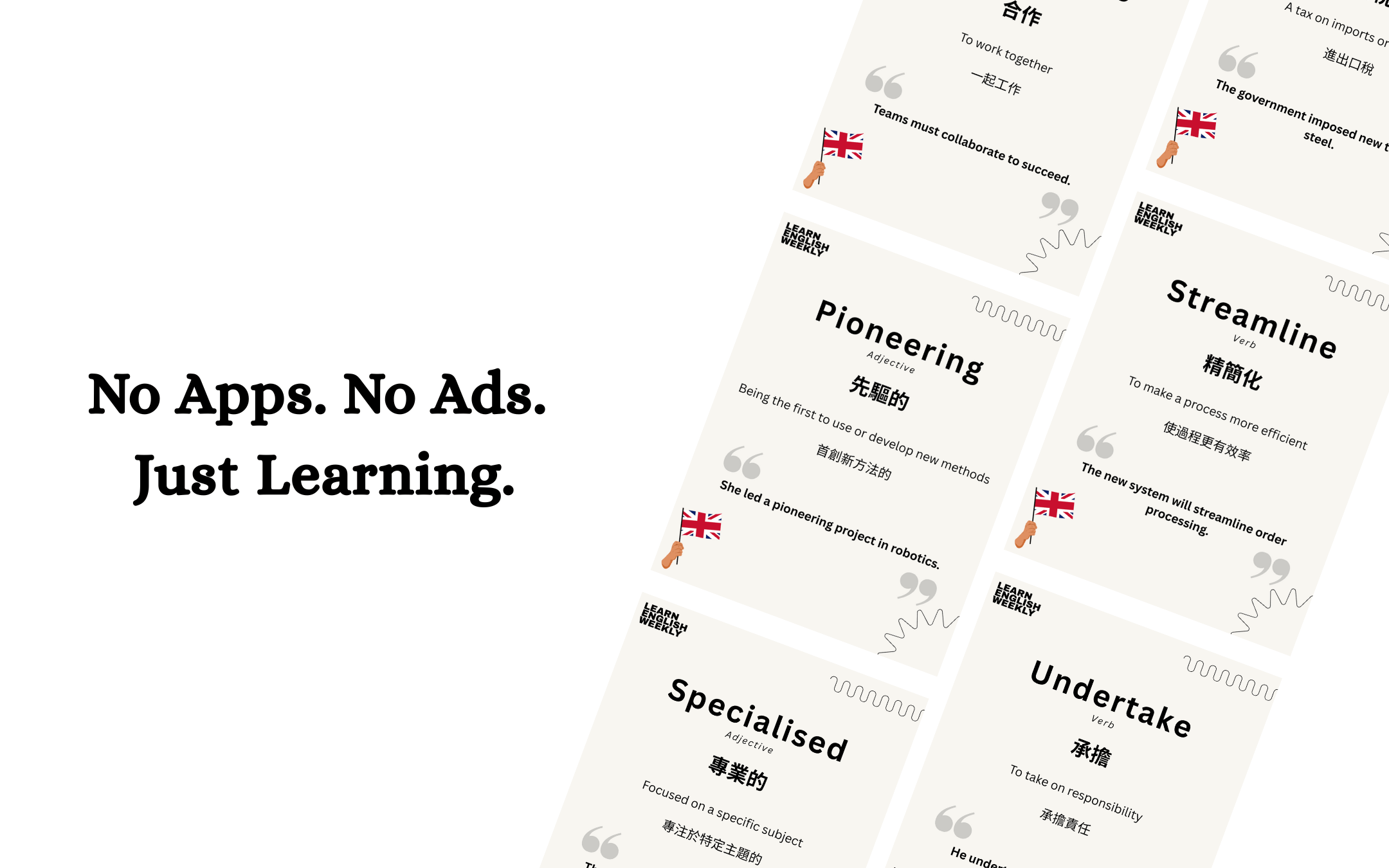
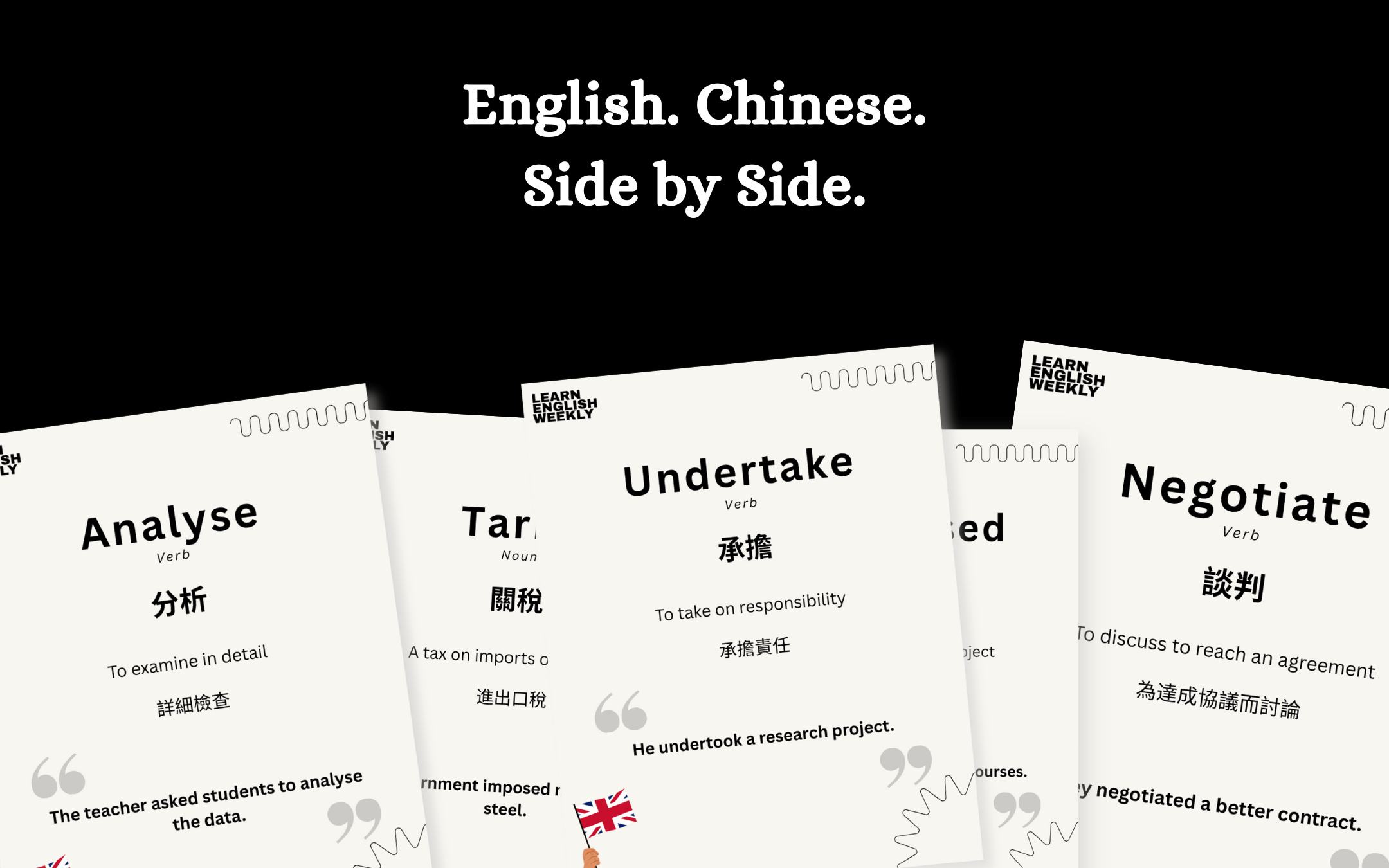
English + Traditional Chinese flashcards with real IELTS example sentences. Remember longer + boost your score. 20 Topics Included.

Education & Learning
Work & Career
Business & Economy
Technology & Innovation
Health & Medicine
Environment & Sustainability
Society & Social Issues
Government & Politics
Crime & Law
Science & Research
Communication & Media
Travel & Tourism
Culture, Art & Literature
Family & Relationships
Psychology & Emotions
Housing & Architecture
Food & Nutrition
Sports & Recreation
Philosophy & Religion
Miscellaneous Vocabulary


Erasmus Schröder, Germany
"This pack changed how I study IELTS vocab. I understand how to use the words now, not just memorise them."

Roy Wilvin, Taiwan
"The bilingual translations make learning so much easier. It definitely helped me get to band 7.5 in two months."
Roei Bahalker, Israel
"Perfect for quick revision before the test. The layout is clear and practical. I use these and watch the social media content, learning more every week!"
Before Stonewall, being "gay" was often conflated with gender non-conformity. In the 1950s and 60s, the homophile movement (the early gay rights movement) frequently distanced itself from "transvestites" and gender-nonconforming people to appear more respectable to straight society. Yet, on the streets of Greenwich Village, at Compton’s Cafeteria in San Francisco (where a 1966 riot preceded Stonewall), it was trans women and drag queens who resisted police brutality most fiercely.
When we say "LGBTQ culture," we must mean a culture where a transgender child feels as safe and celebrated as a cisgender gay adult. Where a non-binary person is not an asterisk but a core member of the community. Where the Stonewall legacy of Marsha P. Johnson and Sylvia Rivera is not a footnote in a history documentary, but the living, breathing ethos of every Pride march, every support group, and every piece of queer art. The transgender community is not a subculture within LGBTQ culture; it is an essential, inseparable part of the whole. To remove the trans experience is not to simplify LGBTQ history but to gut it of its most radical, courageous, and transformative elements. free shemale vids updated
Instead, the most vibrant version of LGBTQ culture is one that follows the lead of trans pioneers—celebrating fluidity, honoring chosen family, and fighting for the most marginalized among us. This means centering trans voices, particularly those of trans women of color, who face the highest rates of violence and poverty. Before Stonewall, being "gay" was often conflated with
This pattern—trans pioneers leading the charge, only to be marginalized later—has repeated for generations. From the AIDS crisis, where trans people died alongside gay men at alarming rates but were left out of research studies, to the fight for marriage equality, where trans rights were often sacrificed as "too controversial," the transgender community has consistently been both the heart and the afterthought of LGBTQ culture. When LGBTQ culture is at its best, it is spaces that celebrate the deconstruction of rigid norms. No group embodies this more profoundly than the transgender community. 1. Redefining Authenticity Mainstream gay and lesbian culture has, at times, focused on the idea of being "born this way"—a static, biological determinism meant to appeal to a straight audience ("We can't help it; it's not a choice"). The transgender experience, however, introduces a more radical, nuanced idea: identity is authentic not because it is fixed at birth, but because it is self-determined. Trans people teach the entire LGBTQ community that authenticity isn't about destiny; it's about courage. This has opened the door for broader conversations about non-binary identities, genderfluidity, and the idea that the self is something we become , not just something we are . 2. The Art of Chosen Family LGBTQ culture has long cherished the concept of "chosen family"—the bonds formed when biological relatives reject you. For transgender individuals, especially trans youth, this concept is not metaphorical; it is often a survival mechanism. Disproportionately high rates of family rejection and homelessness among trans people have meant that trans community members are expert builders of support networks. Trans-led organizations, ballroom houses (famous from Pose ), and mutual aid groups have provided blueprints for resilience that benefit all LGBTQ people. The categories of "mother" and "father" within ballroom culture, often held by trans women and gay men, are sacred, demonstrating that family is an act of will, not blood. 3. Expanding the Language of Desire LGBTQ culture has also broadened straight society's understanding of sex and romance. Trans people challenge the very definition of same-gender and different-gender attraction. A straight man attracted to a trans woman, or a lesbian attracted to a trans woman—these relationships force a rethinking of what attraction means beyond anatomy. This has pushed queer culture toward a more sophisticated, inclusive understanding of sexuality, centered less on genitalia and more on identity, energy, and connection. Points of Tension: Where the Alliance Frays Despite this rich synergy, the relationship between the transgender community and wider LGBTQ culture has not been without conflict. Acknowledging these tensions is essential for growth. Trans Exclusion in Gay and Lesbian Spaces For much of the 1970s and 80s, some lesbian feminist groups adopted "trans-exclusionary radical feminist" (TERF) ideologies, arguing that trans women were infiltrators or, paradoxically, caricatures of femininity. This led to the creation of "womyn-born-womyn" only spaces, which explicitly barred trans women. Even today, while mainstream LGBTQ organizations are overwhelmingly pro-trans, pockets of gay and lesbian communities harbor transphobic attitudes, particularly regarding athletic competition, prison placement, or bathroom access. The "T" as an Afterthought A constant complaint within the trans community is that the "T" in LGBTQ is often silent during non-crisis times. During Pride parades, corporate sponsors happily fly rainbow flags in June but cut trans-specific messaging. Lesbian and gay organizations may eagerly accept trans volunteers for fundraising galas but fail to advocate for trans healthcare access or against the wave of anti-trans legislation (bathroom bills, drag bans, healthcare restrictions for minors) that has swept the U.S. and other nations since the mid-2010s. This has led to a painful realization for many trans activists: gay rights and trans rights are not always the same fight. The Disproportionate Burden of Visibility When anti-LGBTQ legislation is passed, trans people are often the primary target. The "Don't Say Gay" bills and book bans focus heavily on transgender identity and gender non-conformity. While gay marriage is largely settled law in many Western countries, trans existence is still debated on talk shows, in courtrooms, and in legislatures. This has created a dynamic where the broader LGBTQ community benefits from trans people absorbing the brunt of political violence, leading to a form of compassion fatigue where some gay and lesbian individuals distance themselves from trans issues to protect their own hard-won "normality." The Modern Era: Solidarity Under Fire The past five years have been a crucible. An unprecedented wave of anti-trans legislation—over 500 bills introduced in U.S. state legislatures in 2023 alone—has forced the question: Is the LGBTQ community truly united? When we say "LGBTQ culture," we must mean

Hi, I’m Jordan, founder of Learn English Weekly.
I’m a TEFL-qualified English teacher with over 7 years of tutoring experience, and I’ve helped hundreds of students achieve IELTS Band 7+ and beyond.
This flashcard pack was designed from real IELTS material and classroom-tested methods that actually work.
Want to talk? You can get in touch here.
Motheeb Akeel, Pakistan
"Each topic is so well organised. I focused on ‘Work and Career’ and could actually use those words in my speaking test. Totally worth it."

Andres Jiménez, Chile
"These flashcards make it so easy to study little by little every day. Highly recommended. ¡Gracias! 🙏"

Shao Hsuan Peng, Taiwan
"I love that everything is explained in both English and Traditional Chinese, perfect for quick understanding. I need to use these words every day at work!"
Take your learning further with these popular English study packs.
Join the community for free resources and other learning opportunities.
No spam — only valuable English learning content.